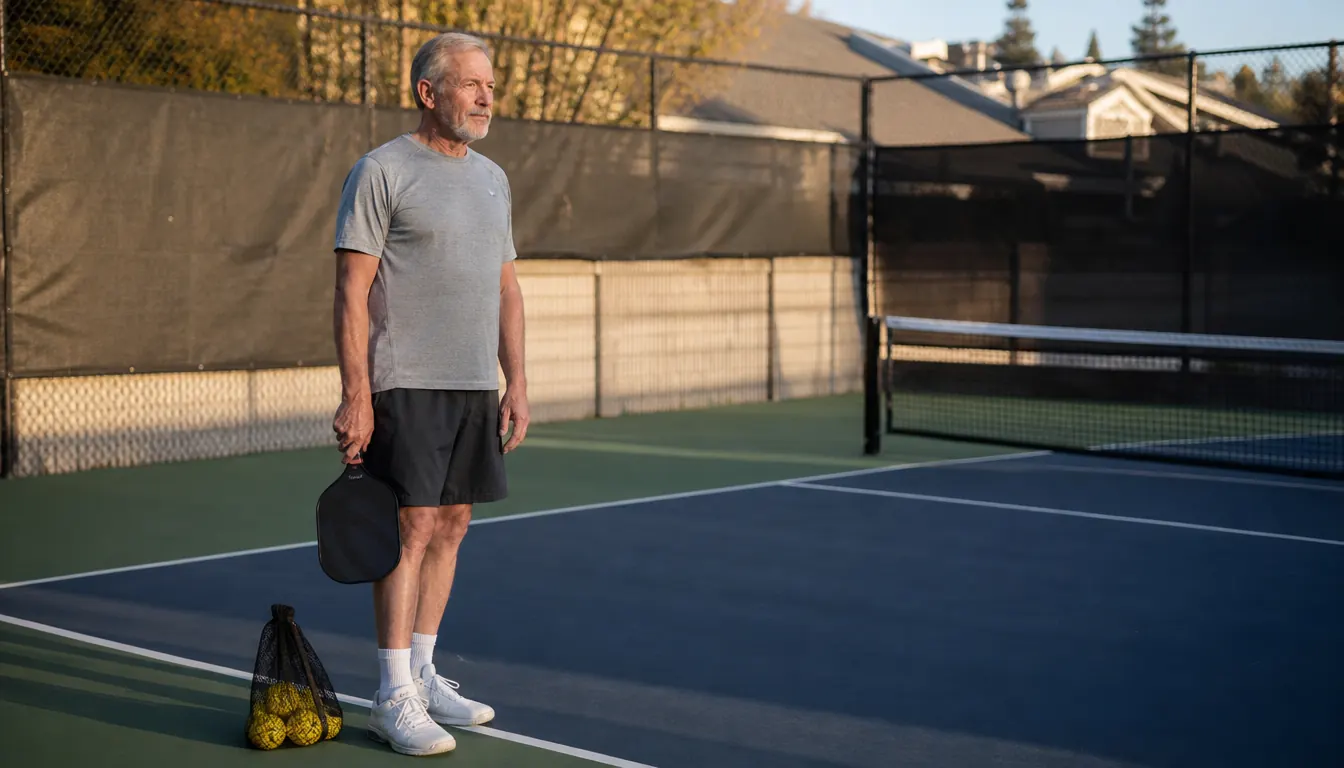
The first paddle I owned was wood, came in a set with two balls and a carrying case, and was the kind of thing you buy before you know whether you will keep playing. I played with it for a summer because I did not know any better. Then a guy at open play handed me his paddle for one game and I understood in about four points that I had been fighting my equipment. The ball came off his face differently. My mis-hits stayed in. I went home and started reading listing pages like they were wiring diagrams.
That was the summer of 2024. I am 64 now, retired from running my own electrical contracting shop for 28 years, and I play four or five mornings a week at a town park about ten minutes from my house. What follows is not coaching advice. I am not a certified instructor and I am not going to tell you a paddle will fix your game. What I can tell you is how I sorted through the choices, what I got wrong first, and why an Onix Graphite Z5 ended up as the paddle I still carry. I read specs the way I used to read breaker panel labels: slowly, and out loud. If you are past 60 and shopping for your first serious paddle, this is the checklist I wish somebody had handed me.
The paddle I landed on after two years of looking
Graphite face, Nomex honeycomb core, 7.84 ounces on the listing, 4 1/4 inch grip. It is the one that stopped me thinking about equipment and let me think about the ball.
Amazon Check Today's Price on Amazon →Step 1: Weigh It, Then Weigh It Again After Twenty Minutes
Weight is the first number on every listing and the one most people read wrong. The Z5 lists at 7.84 ounces. That lands in what the manufacturers call midweight, and midweight is where a lot of older recreational players end up, not because it is magic but because it sits between two problems. I put mine on the kitchen scale out of curiosity. The listing said 7.84 and the scale said 7.9, and that was close enough for me.
The problem on one end is a heavy paddle that feels wonderful for the first ten minutes. There is mass behind the ball and your drives feel substantial. Then you get to the third game and the paddle starts feeling like it is pulling your wrist down at the kitchen line, where the whole point is to hold the paddle up and steady. I noticed this with a heavier loaner paddle a friend from open play uses. I took it for one Saturday morning of doubles with Carol and it was wonderful for about two games. By the middle of the first set I was letting balls go that I would normally chase, and by the end of the morning my forearm was tight in a way it had not been all season. Great for two games, a chore by game four.
The problem on the other end is a very light paddle that feels quick and then transmits every off-center hit straight into your hand. If your hand or elbow is already complaining, that sting is the thing you will remember. Midweight around 7.8 to 8.2 ounces was the range where I could still hold the paddle up for a full morning without my forearm tightening. Your number may differ. Hold three paddles at the shop or borrow three at the courts and play a real game with each, not a demo rally. A demo rally tells you nothing, because you are fresh and you are being careful.
Step 2: Get the Grip Right Before Anything Else
The Z5 grip is 4 1/4 inches, a tennis-style handle rather than the short stubby handle some pickleball paddles use. Onix calls it a tennis handle shape on the listing and that is exactly what it feels like. I came up playing tennis badly in the 1970s, so a handle that feels like a tennis racket felt like home the moment I picked it up. That is a real factor and it is worth being honest with yourself about.
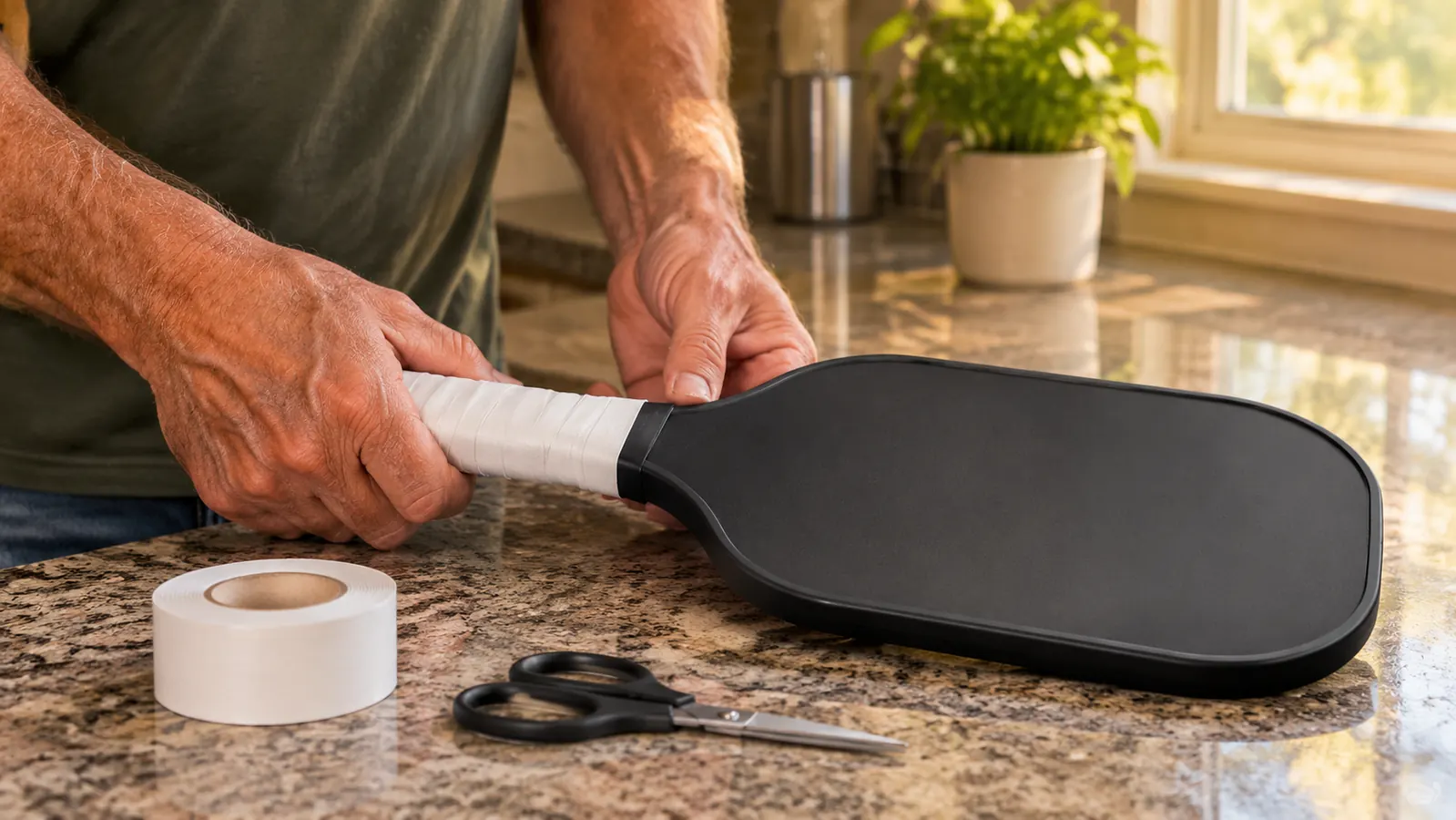
The reason I put grip second and not first is that you can change it. I wrap my Z5 with an overgrip, and that overgrip changes the effective size and the texture in my hand. You can re-wrap a handle in about five minutes and go from a grip that feels slick in August humidity to one that holds. You cannot change a paddle's weight or its face material nearly as easily.
What you want to check is whether your fingers wrap all the way around and touch your palm comfortably, and whether the handle length lets you get both hands on it if you play with a two-handed backhand. If you have any kind of hand or wrist issue, that is a conversation for your doctor, not for a paddle review. I had some tightness in my right elbow in my first season and I asked my own doctor about it and I rested it. A grip size that lets you hold the paddle loosely instead of squeezing hard is what I would look for, and I will leave the medical side to the professionals.
Step 3: Understand the Face and the Core, Because That Is Where the Feel Lives
Two specs do most of the work on any paddle. The face material and the core. Onix builds the Z5 with a graphite face, a carbon fiber frame and a Nomex honeycomb core, and the listing describes it as medium-weight with an emphasis on ball control. That description is accurate to what I felt, and I want to be precise about what control means in practice, because it gets thrown around like a compliment.
Graphite faces, in my experience, feel stiffer and give you a more direct response than the softer composite faces some beginners start with. What that meant for me was that when I tried a dink and got it right, I felt it. When I got it wrong, I felt that too. That feedback is what I wanted, and it is exactly what some players hate. A friend from open play has a cheaper paddle with a different face and core, and he likes how forgiving it is. He is not wrong. He is just looking for a different thing than I was.
The Nomex honeycomb core gives the paddle a lively, popping quality rather than a soft, cushioned one. If you want a paddle that absorbs pace and softens the ball, this is not that paddle. If you want something that puts the ball back out with a little energy of its own at the kitchen line, this is. Read the listing bullets and translate them. Amazing ball control on a product page means the manufacturer is claiming the face and core combination rewards placement. Whether it rewards your placement is something only a couple of real games will tell you.
For the first month I owned the Z5 I kept a three-line note in my phone after every morning: what worked, what did not, and one thing to try next time. By the end of that month the same line showed up eleven times. My drops were landing short. That was me and my touch, not the paddle. But the paddle was giving me a clear enough signal that I could hear it, and I do not think I would have noticed the pattern with a face that swallowed everything.
I stopped fighting my equipment the day a paddle fit my hand, my grip and my morning, not the day I found something with better numbers.

Step 4: Measure the Face, Because a Bigger Face Is Not Cheating
The Z5 is 15.5 inches long and 8.3 inches wide. When I measured it against the paddle I had been using, the difference was not dramatic, but the shape was. I did that measuring on the workbench in my garage with a framing square, the same way I would check a piece of conduit before I cut it, and the numbers on the listing matched what the square said. A wider body gives you more surface where the ball can land and still go where you aimed. For a player who learned this game in his sixties, that margin is worth more than any spec on the marketing sheet. I mis-hit less with a wider face. That is not a skill gain and I will not pretend it is. It is just geometry doing a bit of the work.
What you give up for that width is a little bit of reach and a little bit of hand speed at the net, because the paddle is not as long and nimble as a narrow elongated shape. If your game depends on snapping your wrist through fast exchanges, you may want the opposite. If your game, like mine, is more about getting the ball back over the net consistently and placing it where the other team is not, then a wider face is not a beginner crutch. It is the right tool.
Step 5: Read the Warranty, the Rating and the Bad Reviews Before You Buy
This is the step almost nobody does and it takes ten minutes. The Z5 has a one year limited warranty listed, and it has a rating in the mid fours across several hundred reviews. A high rating tells you most people are not furious. It does not tell you anything about your game. What it does tell you, when you read the low reviews carefully, is where the product tends to fail. Look for patterns in the complaints: a handle that came loose, a face that delaminated, a grip that wore through. One grumpy review is a person having a bad week. Six that say the same thing is a design issue.
I also want to say something about the reviews that call a paddle too advanced. Most of the time that means the player wanted a softer, more forgiving face and got something with more feedback than they expected. That is not a defect, that is a mismatch, and it is exactly the kind of thing you can find out by reading twenty reviews instead of two. I read mine over a Saturday morning with a cup of coffee and a pad of paper, and I wrote down every complaint that showed up more than twice.
One more practical note. Two of my regular partners own multiple paddles and cycle through them depending on the day, the weather, and how their arm feels. You do not have to do that. But if you buy one paddle and play with it for twenty or thirty sessions, you will actually know what you have. Switching every week teaches you nothing because you never build the feel that tells you what changed. I have played the same Onix for two seasons now and I can tell you what it does on a cold morning in April versus a humid one in August.
What Else Helps
A paddle is one piece of a morning, and the other pieces matter more than I expected. The right shoe is the first one. I wore running shoes on the court for the better part of two seasons and they were terrible for the side-to-side movement this game asks for. Court shoes with a rubber sole that grips the surface made more difference to how confident I felt moving than any paddle ever did. That is a genuine gear upgrade and it does not involve a single number on a spec sheet. I bought mine in March 2026 and I wear them only on court, never for walking around, because the sole picks up grit from a parking lot fast.
The second is a bag that keeps your stuff in one place. Mine has a hook that hangs on the fence at the outdoor courts so my paddle is not sitting on the ground collecting grit. The third is a supply of outdoor balls that are actually outdoor balls, because the two types play genuinely differently and mixing them wastes a morning of practice. I keep a loose dozen in a mesh bag behind the seat of my truck so I am never the guy asking to borrow one. And the fourth is showing up at the same time every week so you get to know the people. I learned more in one summer of standing next to better players than I did from every listing page I ever read.
If your paddle is what is bothering you, this is the one I play with
7.84 ounces, graphite face, Nomex honeycomb core, 4 1/4 inch grip, 15.5 by 8.3 inches. It has survived two seasons in my truck and it is still my main paddle.
Amazon Check Today's Price on Amazon →