
The first bag of outdoor pickleballs I ever retired still bounced. That is the part that gets you. I pulled them out of the mesh bag on a Tuesday morning in July, dropped one on the garage floor, and it came back up looking like a ball that had done nothing wrong. Then I played two hours at the town park and sprayed shots I normally do not spray. The ball was not dead. It was halfway, which is worse, because halfway is the state where you blame your own hands for six weeks.
I am Dennis Mercado. I am 64, retired after 28 years running a small electrical contracting shop here in Warwick, Rhode Island, and I play outdoors four or five mornings a week from April until the cold pushes me inside around early November. That is a lot of hours on a lot of balls. My first 12 pack of Tourna Strike outdoor balls went into my bag in April 2025 and I have bought several more since. Here is what I have figured out. Outdoor balls do not fail the way people expect. They do not pop. They soften and go out of round slowly enough that you spend weeks thinking you have gotten worse at pickleball.
Before you blame your hands, put a fresh ball in play
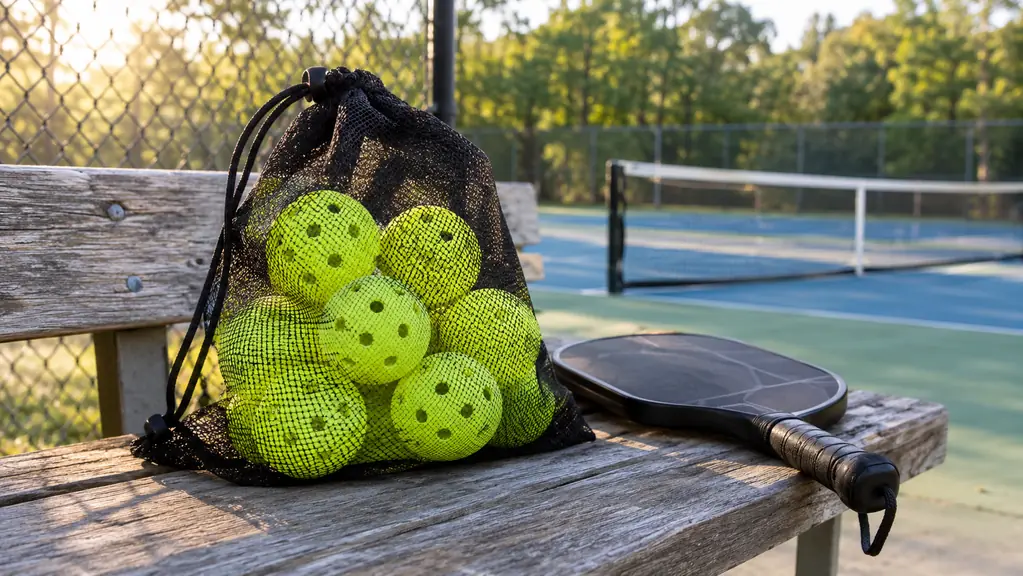
Tourna Strike outdoor pickleballs, 12 to a mesh bag, 74 mm across and 24.5 grams each on the listing, with 40 drilled holes. A fresh ball is the fastest way to find out whether the problem was ever you.
Amazon Check Today's Price on Amazon →Step 1: Squeeze the ball before you trust it
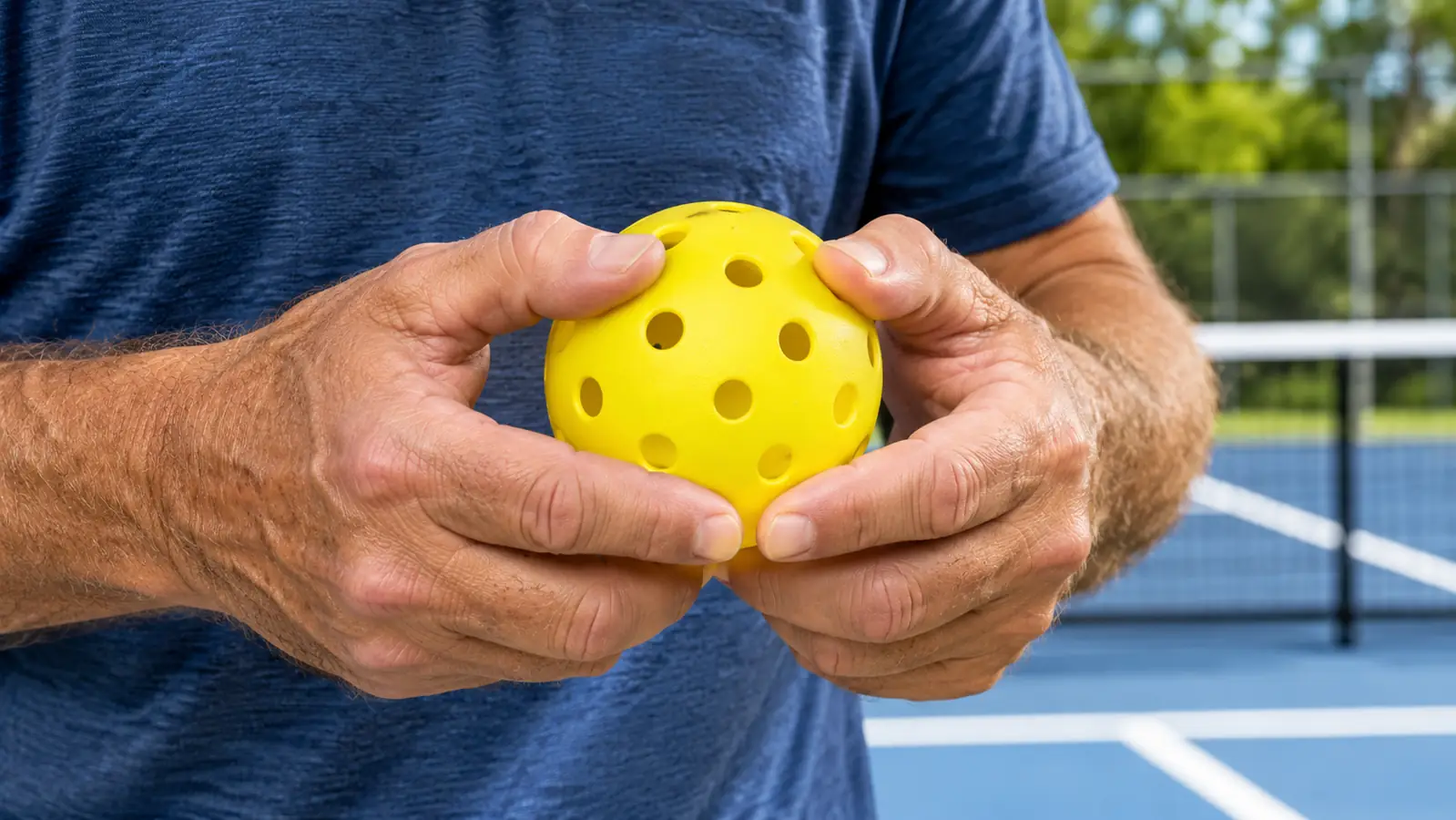
This takes four seconds and it catches most of the bad ones. Hold the ball in one hand and press the pad of your thumb into the wall between two holes, then roll it a quarter turn and press again in a new spot. A fresh outdoor ball pushes back. The wall is firm and it springs. A ball that has been through a season gives under your thumb, and if you hold the pressure for a second you can feel it stay slightly dented before it comes back.
The catch is that hand strength varies, and mine is not what it was at 40. So I do not trust the squeeze on its own. I keep one ball from a new bag in the truck as a reference. When I am not sure about a ball, I squeeze the reference first, then the suspect. It sounds fussy. It is the same habit as keeping a known good meter lead on the bench, and it takes two minutes at the start of a session instead of two hours of wondering in the middle of one.
One more thing about the squeeze. Do not test a ball that has been sitting in a cold truck bed all morning and then decide it is worn out. Plastic stiffens when it is cold, and it will fool you in the other direction, into thinking a tired ball is fine. Let the balls come to the temperature of the day before you judge them. The same ball can feel noticeably different at eight in the morning in April and at noon in July.
Step 2: Look at the holes and the seam, because that is where they fail first
The Tourna Strike has 40 drilled holes, and each one is a stress point. Hold a ball up against the sky and rotate it slowly. What you are looking for is a hairline running out from the edge of a hole. Early on it is faint, a change in how the light sits on the surface more than a visible crack. Later it opens up.
Run your thumbnail around the rim of a few holes. Fresh balls feel smooth at the edge. Worn ones get rough, and sometimes a burr of plastic lifts where the wall has started to go. Then check the seam where the two halves of the ball meet. Any crack you can catch a nail on means that ball is done, even if it still bounces fine on the garage floor. A ball with a live crack in it can split in the middle of a rally, and the point is over, and it is over in a way that leaves everybody standing around looking at the pieces.
I check a whole set at once, sitting on the tailgate, turning each ball over in my hands. Twelve balls takes about five minutes. The ones that fail go in a bucket and the rest go back in the bag. It is a boring job and I do it roughly once a month during the outdoor season, which is often enough that I am never surprised on the court. What I usually find is one or two balls that are clearly finished and a couple that are borderline.
Step 3: Drop it on concrete from the same height every time
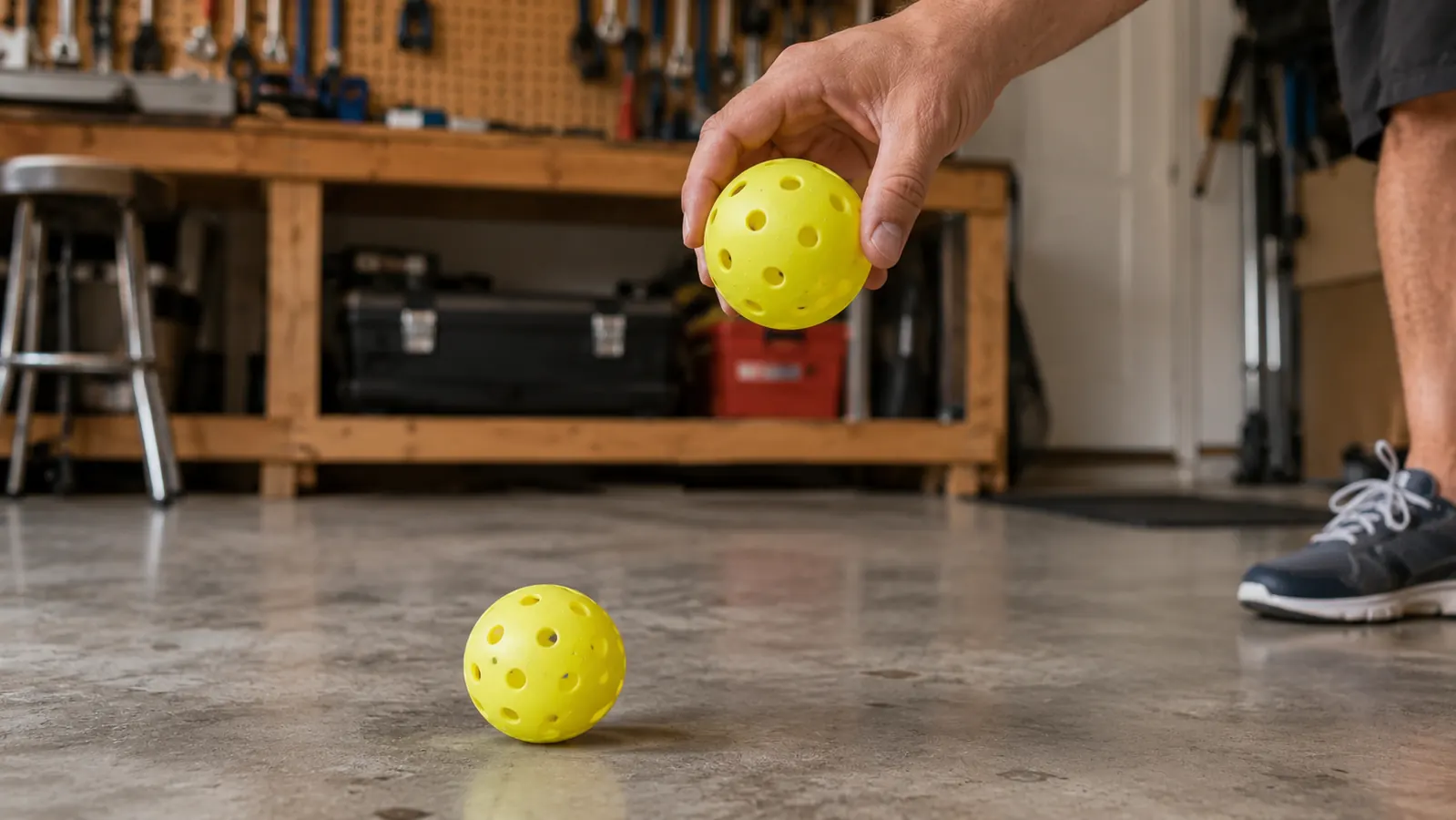
This one is for the balls you are on the fence about. Hold the ball at shoulder height, drop it on a flat concrete floor, and watch how high it comes back. Then do the same thing with a reference ball from a new bag. You are not measuring anything. You are comparing. A tired ball comes back lower and sounds flatter, a duller thump instead of a bright tick.
While you are down there, roll it. A ball that has gone out of round will wander across a flat floor instead of tracking straight, and you will see it before you feel it. I do all of this in the garage, not at the courts, because doing it on the court in front of a dozen people is a whole production and I would rather just know.
The drop test also tells you about sound, and sound is the thing my ear picks up before my hands do. A fresh ball has a bright, hard tick when it hits concrete. A spent one is duller, and once you have heard the two side by side you will hear it across the court without trying. That is not a measurement either. It is just a thing you learn to notice.
Step 4: Watch the flight, especially into the wind
This is the honest test, and it is the one nobody wants to run, because it involves admitting you might be the problem. The listing says the 40 holes are drilled to minimize wind interference, and with a fresh ball I believe it. Serves track. Dinks stay down. When the ball has softened, the flight gets squirrelly in a way that is hard to describe and easy to recognize once you have seen it. Serves drift. Balls that should land at the kitchen line float long.
So separate the two. Take one ball from a new bag and hit ten serves with it. Then take the suspect ball and hit ten more, same motion, same target. If the second ten look different, the ball is the difference. Do it on a calm morning. On a gusty day every ball behaves badly and you will learn nothing except that wind exists.
Where this really shows up for me is the serve. My serve is not a weapon, it is a placement shot, and I know roughly where it should land. When I am hitting long by a foot with a motion that feels identical to the one I used the week before, I stop and check the ball. More often than not the ball is the answer and I have been standing there negotiating with myself about my mechanics for no reason at all.
Step 5: Date the bag and rotate on a schedule
Take a marker and write the month and year on the mesh bag the day you open it. I started doing this after the July I described above, and it is the single change that has saved me the most aggravation. A dozen balls in regular open play, four or five mornings a week, will not last a full outdoor season at my house. Writing the date on the bag means I stop guessing and start knowing.
I keep two sets going. One is in play, one is waiting in the garage. When a ball fails the squeeze, or the seam check, or the drop test, it goes in the bin and a ball from the waiting set comes out. That way I always have a known fresh ball on hand to compare against, and I am never doing arithmetic in my head while somebody is waiting on my serve. The 12 pack is the smallest unit that lets you do this properly. Half a dozen is not enough to rotate.
One caution about schedules. The date on the bag is a reminder, not a rule. A set that has lived in a cool garage and only come out on Saturdays will outlast a set that spent July in a hot truck. Use the date to prompt the check. Do not use it to replace the check.
A ball with a live crack in it can split in the middle of a rally. A soft one is quieter than that. It just makes you look like a worse player than you are.
What Else Helps
Heat is the quiet killer. I keep my court bag behind the seat of the truck, and a closed cab in a Rhode Island July gets hot enough to cook. For two summers I left the whole bag back there and could not figure out why my balls felt tired by August. Now the balls come inside with me and the bag goes back out in the morning. Nothing scientific about it. They just last longer.
Do not judge outdoor balls against the indoor ones at the community center. I play in the gym through the winter and those balls are the gym's, and they feel different in the hand, softer and livelier off a wood floor. That is the construction, not wear. If you spend a winter on indoor balls and then pick up an outdoor ball in April, it will feel dead to you for a week. Judge it against another outdoor ball.
The mesh bag the 12 pack comes in is worth keeping. It lets air move, it keeps the set together, and it lets you see at a glance how many you have left. It also hangs off the fence hook on my bag at the park, which keeps the balls off the ground between games.
The court surface matters too. The outdoor courts I play on are a hard acrylic over asphalt, and a hard surface is harder on balls than anything else I have played on. The same balls have lasted longer on softer surfaces. That is not something I can control, but it is worth knowing before you conclude that a set died early for no reason.
I also keep four balls set aside that never go into open play. They are my serving and drilling balls for the afternoons when the courts are empty. Using the tired ones for practice and the good ones for games is backwards from how most people do it, but it means the balls that matter are always fresh and the ones getting hit into a fence two hundred times are already on their way out.
And if you are the person who shows up with three balls and one of them is eight months old, buy the dozen and split it with your regular group. I have done this twice. Everybody gets four fresh balls, the cost per person is trivial, and nobody spends the morning quietly wondering whether it is the ball or them.
Start with a dozen you can date, rotate and trust
I have bought several bags of Tourna Strike since April 2025 and I keep buying them for one reason. I know what a fresh one feels like, so I know when one is done. Put a dozen in your bag, write the month on the mesh bag, and stop guessing.
Amazon See the Tourna Strike 12 Pack on Amazon →