
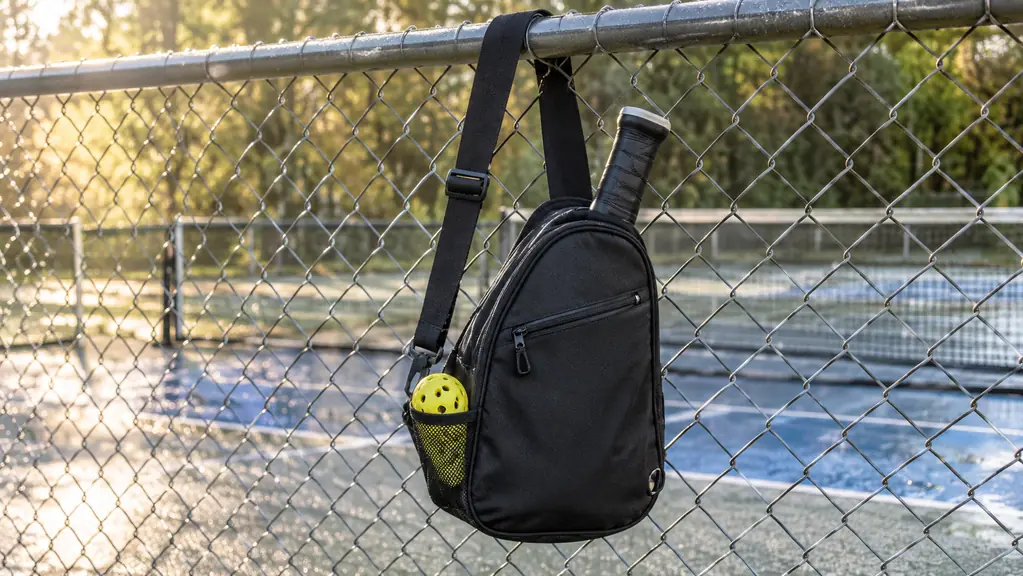
I bought the Franklin Sports pickleball sling bag in May 2026 because the zipper pull on my old gym bag came off in my hand, and I was tired of digging a paddle out from under a wet towel every morning. Six months of open play later it is still the bag that rides behind the seat of my pickup. But the details I would want to know before buying it are not the details the product photos show, and two of them would have changed how I packed it from the first day.
So this is the version I wish I had read back in the spring. Not the listing features recited back at you, but what the bag is actually like at eight in the morning with two paddles, a sleeve of balls, a towel, a bottle and a phone in it, hanging on a fence while I play. The Franklin Sports sling is a good bag for a fairly narrow job. Being honest about how narrow that job is takes up most of what follows, and I would rather you decide with the whole picture than find out at the courts.
The Quick Verdict
A well made single strap bag that carries two paddles and a morning of gear without complaint, as long as you stop expecting it to be a locker.
Amazon Check Today's Price →The bag that has hung on a fence four mornings a week since May
Polyester shell, an adjustable sling strap, a padded spot for a phone and keys, and a fence hook inside the big pocket. Six months of open play and nothing has let go.
Amazon Check Today's Price on Amazon →What Nobody Tells You Before You Buy a Sling Bag
A sling bag is not a backpack with one strap taken off. It rides across your back at an angle, and everything inside it settles toward the low corner. That is fine for a paddle, a towel and a phone. It stops being fine when you pack it the way you used to pack a duffel bag and then spend the walk from the parking lot pushing it back around to your spine. The shape of the bag decides where the weight goes before you do, and no amount of careful packing argues with it.
The second thing nobody says out loud is that a fence hook changes your whole routine. You stop setting the bag on the ground. If you have ever knelt on wet pavement in April to fish a ball out of a bag, you know exactly why that matters, and if the courts near you drain badly after rain you know it more than most. The bag hangs, the bag stays dry, and your knees do not have to get involved. I noticed the difference in the first week and I have not set it down since.
The third thing is the honest arithmetic. A soft sided bag is smaller in practice than its measurements suggest. The listing gives 18.5 inches long, 13 inches wide and 8 inches high, and my first read of those numbers had me thinking I could get a week of gear in there. What I actually carry is a paddle, Carol's paddle on Saturdays, a sleeve of outdoor balls, a towel, a bottle and my keys, and that is a full morning. There is room left over for a light jacket or a spare shirt. There is not room left over for shoes.
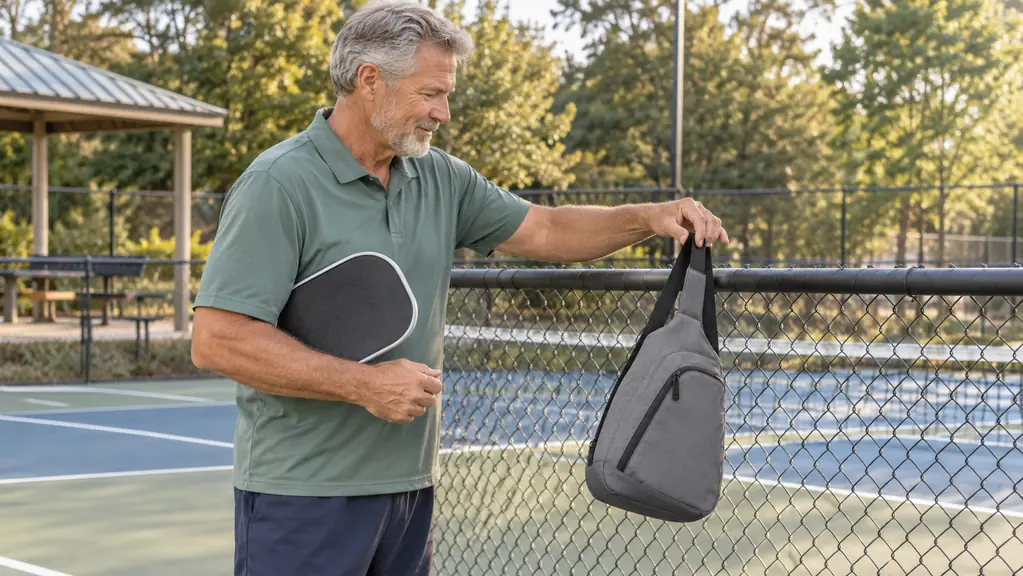
How I've Used It
I play open play four or five weekday mornings at the town park about ten minutes from my house, usually from eight until about half past ten. Carol and I play doubles together on Saturdays. From April into early November those are outdoor courts, and when the weather turns I move inside to the community center gym, where the courts are indoors and I use the gym's own balls. The bag has gone to every one of those sessions since May, outdoors and in.
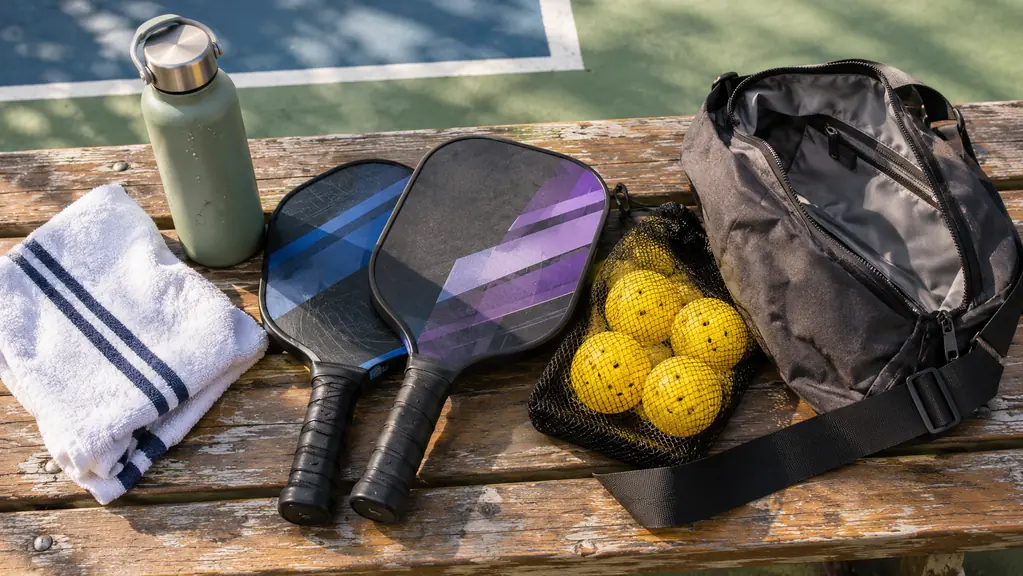
The routine does not change. I load it the night before and leave it behind the seat of the truck, which is the closest thing I have to a locker these days. Paddle in first, then the sleeve of Tourna outdoor balls, then a towel folded flat, then the bottle, then phone and keys in the padded spot. Out of the truck, one strap over the shoulder, and it is on the fence before I have my shoes tied.
I am not gentle with gear. I am sixty four and I carried tool bags for a living for twenty eight years, so I treat a bag like a bag. What I can tell you after six months is that nothing on this one has let go. The zipper still runs clean, the strap has not frayed where it meets the body, and I have not had to re-stitch a seam. That is a low bar, and a surprising number of bags miss it.
One more habit worth mentioning, because it is where the bag earns its keep. Twice a week I stay after open play and drill serves and drops by myself with the Tourna pickup tube, which lives in the truck bed. The bag hangs on the fence while I do it, mouth open, and I pull balls out of it one at a time. A bag that had to be unzipped and rezipped for every ball would have sent me back to a bucket inside a week.
Winter is the real test for a bag like this, and I have only had one of those with it. In the gym the bag goes on the bench beside the court instead of on a fence, and the open mouth trick does not work as well because I am not standing next to it. It still carries what I need. It just does less for me indoors, and I want to be straight about that rather than pretend the fence hook is a feature in every setting.
What I actually carry is a paddle, Carol's paddle on Saturdays, a sleeve of balls, a towel, a bottle and my keys, and that is a full morning.
The Six Paddle Number, Read Honestly
The listing says the bag holds up to six paddles, and I have no reason to doubt it. Six paddles is a stack of paddles and very little else. The one time I came close was a Saturday when Carol and I brought two spare paddles for a couple who were thinking about taking up the game. Four paddles, two sleeves of balls and a towel filled the big pocket to the point where I had to work the zipper shut around the corner.
That is not a fault. It is arithmetic. Six paddles is a number for a team bag or for a rep hauling demo paddles to a clinic. If you are one person going to open play, the useful number is two paddles and a morning of gear, and the bag handles that without any strain at all. Where it gets tight is the middle ground, the four or five paddle morning, and that is the range a lot of club players will actually live in.
What I would tell a friend is this. Buy it for two paddles and be pleasantly surprised when it swallows four. Do not buy it expecting to carry a full team's paddles plus water and towels and a change of clothes, because something has to give and it will be the towels every time. Nobody puts that in a product description, and it is the single most useful thing I can pass along. The bag is honest about it once you have it in your hands. The listing just lists a number.
The Strap, the Weight and the Swing
The bag weighs 15.2 ounces empty, which is not nothing, but it is the strap you feel rather than the bag. It is a single adjustable strap and the whole load rides on one shoulder. With two paddles and a bottle that is a few pounds and I do not notice it walking in from the lot. With four paddles and two bottles I noticed it by the time I reached the far courts.
The other thing about a sling is the swing. When you bend at the waist to pick up a ball, the bag rotates around to your front, and when you stand up it stays there until you push it back. I have gotten used to it, and now I swing it around on purpose so it sits on my hip while I drill. If you are a person who is bothered by a bag that moves, this shape will bother you, and I would rather say so.
The shell is soft. That is what makes it comfortable against your back and it is also what makes it slump when you set it on a bench. It will not stand up on its own. That is not a defect in the bag, it is what a soft sided bag does, and it is the reason the fence hook matters as much as it does. Franklin Sports built a bag that wants to hang, and the design is consistent about that from the strap down to the flat back panel.
There is one adjustment I made in the first week that I would pass along. I shortened the strap until the bag sat high on my back rather than at my hip. Low, it bounced against my leg on the walk in and swung hard when I bent over. High and snug, it stays put and the weight sits closer to my spine. The strap is adjustable enough to do that with room left over, and Carol can lengthen it back out when she carries it.
What I Liked
- Carries two paddles plus a morning of gear without any strain
- The fence hook keeps it off wet pavement and off my knees
- Padded spot for phone and keys means neither one ends up loose in the bottom
- Polyester shell and zipper have held up to six months of four morning weeks
- Adjustable strap sits high and snug on my back and lengthens out for Carol
Where It Falls Short
- The six paddle capacity is real, but it leaves room for nothing else
- A single strap puts the whole load on one shoulder
- No separate bottle pocket that I could find
- The 90 day limited warranty is a short window for daily use
- A soft shell will not stand up on a bench
The Fence Hook Is Inside the Bag
Here is the detail I got wrong from the photos, and I suspect I am not the only one. The fence hook is not on the outside of the bag. It is inside the largest pocket, which is exactly what the Franklin Sports listing says and not at all what I assumed when I looked at the picture. The first morning I used it I stood at the fence with the pocket open, feeling around for a hook I was sure would be on the back panel.
It works, and once you know where it is, it takes about two seconds. You open the big pocket, hook the strap over the top rail, and let the bag hang open against the fence with the mouth facing you. That open mouth turns out to be the good part. I can reach a ball without unzipping anything, and at the end of the morning I sweep everything back in with one hand and carry it out.
The catch is that the bag hangs open. If it rains, or the courts are dusty and the wind is up, the inside of your bag is exposed to whatever the sky is doing. I keep a towel laid across the top for that reason. It is a small thing. It is also the sort of thing a product photo cannot show you and a review should, because it changes how you load the bag on a doubtful morning.
The Pockets and the Zipper
What the listing calls dual padded cell phone and key storage is a small padded sleeve inside the bag, and it is the feature I use most. Before this bag my phone lived in my front pocket and my keys lived in a mystery pocket of the old gym bag, and I lost ten minutes one morning patting down every pocket I owned. Now both live in the same padded spot and I know where they are before I reach for them.
There is also a stash pocket, which is where the small stuff goes, and the main compartment, which is where the paddles and balls go. That is the whole layout. It is not a bag with eleven clever compartments and a label on each one. If you like a place for everything, this is a simpler bag than you are hoping for, and I would rather tell you now than have you find out on a Saturday.
The zipper is a plain one with a decent pull, and it has not caught or split in six months. The warranty is 90 days limited. I will be blunt about that number. For something you carry four mornings a week, 90 days is a short window, and it is the one part of the listing that made me hesitate. Mine has been fine. A warranty is not a review, though, and I would rather you know the number going in than find it in the fine print later.
What I Was Using Before
For the first two years I played out of a canvas gym bag I had owned since the nineties. It held everything. That was the problem. Paddles went in loose with shoes and a towel and a thermos, and every morning began with a search. I also tried a plastic tote for a month, which was easy to see into and miserable to carry, and I tried carrying nothing but a paddle and a bottle in my hands, which worked until the first cold morning when I wanted a jacket.
The sling bag solved the search problem and the carrying problem at the same time, which is why I have kept using it. It is not that it holds more than the gym bag. It holds less. It is that what it holds is findable, and the thing hangs on a fence instead of sitting in a puddle of whatever the pavement is doing that morning. If your current bag is bigger than mine was and you are still hunting for your keys, you already understand the trade.
Who This Is For
This bag suits the player who drives to the courts, plays a couple of hours, and drives home. It suits someone who wants one strap, a fence hook and a known place for a phone and keys. It suits a doubles pair who each bring a paddle, since two paddles plus balls plus a towel is squarely inside what the Franklin Sports bag does well. If you play four or five mornings a week the way I do, loading it the night before becomes part of the morning, and the bag disappears into that routine, which is the highest compliment I can pay a piece of gear.
Who Should Skip It
Skip it if you carry shoes, a change of clothes and a large bottle, because the bag will hold the shoes or the bottle but not both alongside two paddles, and you will end up carrying a second bag anyway. Skip it if you have shoulder trouble, since a sling loads one side and there is no second strap to share the weight, and that is a question for your doctor rather than for me. Skip it if you want a bag that stands on a bench and opens like a toolbox. And skip it if you are hauling gear for a group, because six paddles is a real number and it is all the room there is.
Six months, four mornings a week, and the zipper still runs clean
If your routine is one player, two paddles and a morning at the courts, this is the bag I would hand you. Read the listing yourself on the fence hook placement and the 90 day warranty before you order.
Amazon Check Today's Price on Amazon →