
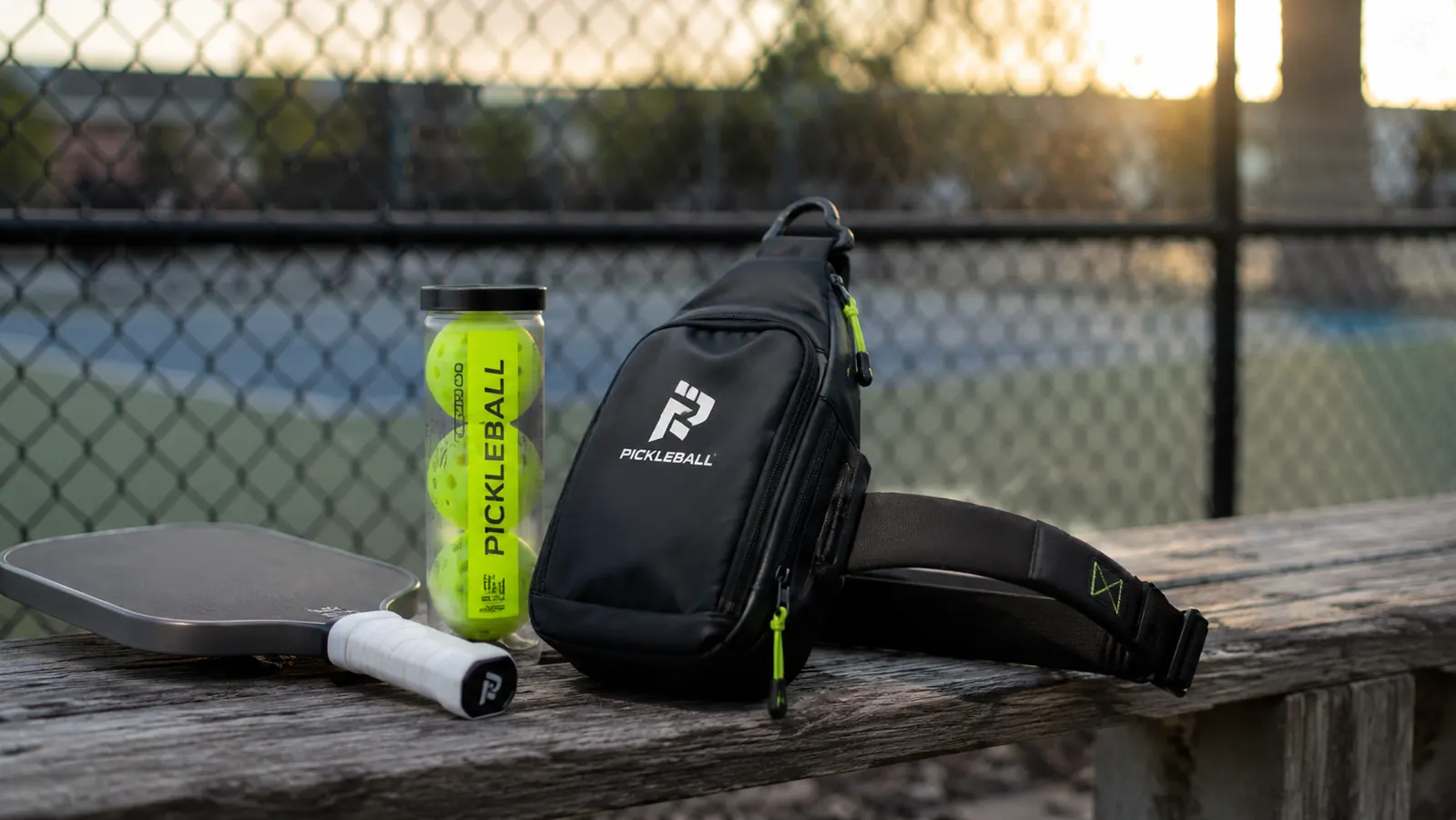
For the first year and a half I played pickleball out of a canvas duffel that had spent a decade riding around the back of my truck on job sites. It held everything. That was the whole of its job description. What it also did was turn every morning into a small search party. Paddle somewhere under a sweatshirt. Balls rolled into a corner. Phone loose beside a water bottle that had a habit of not being quite closed. I would get to the town park courts ten minutes from my house already annoyed, and that is a silly way to start a morning you were looking forward to.
I bought the Franklin Sports pickleball sling bag in May 2026, mostly to end the search party. Six months later it has been to open play four or five weekday mornings a week, to Saturday doubles with my wife Carol, and to the community center gym now that the outdoor season has shut down. I paid for it myself on Amazon, the same as everything else I write about. What follows is what I actually found over those months, including the parts I do not love.
The Quick Verdict
A light, sensible sling that carries a morning's gear without complaint and hangs off the fence where you can see it. The strap is unpadded, the shell is soft, and Franklin Sports does not claim it keeps rain out.
Amazon Check Today's Price →The bag that ended my ten minute morning search
18.5 by 13 by 8 inches and 15.2 ounces on the listing, with room for two paddles, a sleeve of balls and a Saturday's worth of gear for two people. The built in fence hook is the part I would not give up.
Amazon Check Today's Price on Amazon →How I've Used It
My week is fixed enough to be boring, which makes it a decent test. Open play at the town park courts, 8:00 to about 10:30, four or five weekday mornings. Saturday is doubles with Carol. From April into early November that is outdoors on a hard court. In the winter we move inside to the community center gym, where the courts are tighter and the noise is worse and there is no fence to hang anything on.
So the bag does one thing, over and over. It comes off the shelf in my workshop, rides on the passenger seat of the truck, goes to a bench or a fence at the courts, and comes back. Six months of that is somewhere north of a hundred round trips. Not once in all of them did I have to think about the bag itself. For a piece of gear that costs less than a decent paddle, that is the highest compliment I can pay it.
The hardest day it had was a Saturday in August when Carol left her own bag on the kitchen counter and I carried for both of us. Two paddles, a sleeve of balls, two bottles, a towel, my keys, and both phones. It took all of it and still zipped shut. I would not want to haul that load on a long walk, but from the truck to the fence it was no trouble at all.
It also lives in the truck more than it lives in the house, and that has been a quiet benefit. When I was still using the duffel, the duffel stayed behind the seat because it was too big to bother carrying inside. The result was that I never really knew what was in it. The sling is small enough and light enough that it comes in, gets emptied, and gets repacked the night before. That habit alone means I have not once driven to the courts without balls.
What It Actually Holds
The listing gives the dimensions as 18.5 inches long, 13 inches wide and 8 inches deep, at 15.2 ounces empty. The material is polyester with what Franklin Sports calls a soft shell, and it closes with a zipper. There is a stash pocket on the outside and an adjustable shoulder strap. It is one size, there are no wheels, and the warranty is 90 days limited. Those are the numbers. Here is what they mean in a parking lot at ten to eight in the morning.
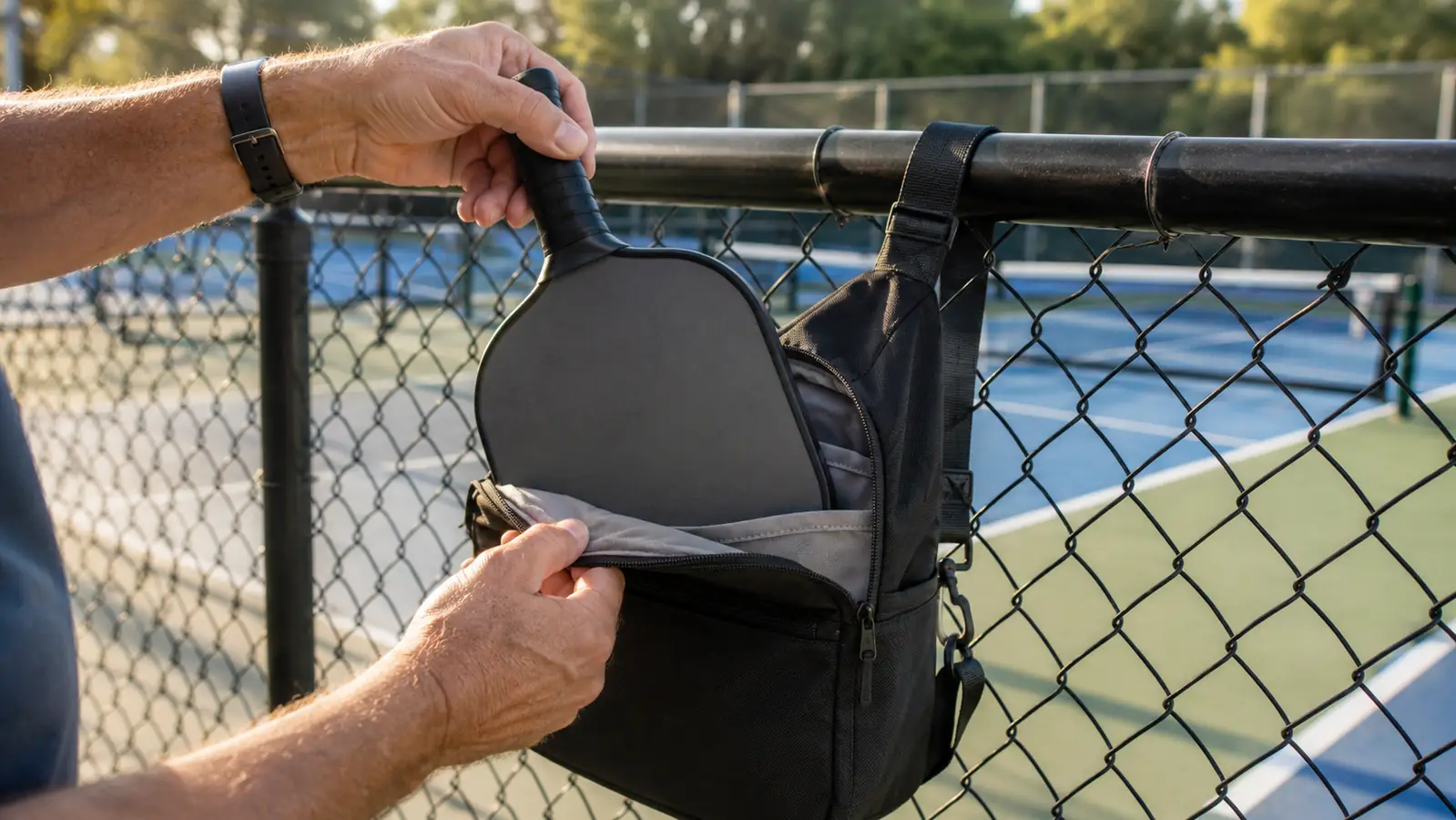
The racket capacity is listed at six paddles. I have never carried six paddles and I doubt I ever will, since I own exactly one and Carol owns one. What I can tell you is that two paddles slide into the largest pocket and lie flat, one on either side of the fence hook, and they stay flat. I have driven the truck over Warwick's version of a washboard road and opened the bag to find both paddles exactly where I put them. No edges digging into the fabric, no grips bent out of shape.
The phone and key storage is its own padded section, and this mattered more than I expected. My phone used to ride loose in the duffel against a bottle and a towel. Now it goes in the padded pocket, and my keys go with it. I have not once had to pat down three pockets looking for a key fob while four people waited on me to serve.
Balls go in the main compartment loose, or in a mesh bag if I am bringing a dozen for a weekday afternoon drilling session. There is no dedicated bottle sleeve, so my bottle rides in the main pocket with everything else. That has not caused a problem, because the bottle I carry is a screw top that actually closes. If yours is the flip lid kind that weeps in a hot truck, you will want to think about that before you pack it against a towel.
The stash pocket on the outside handles the small things. Mine holds a spare overgrip and a couple of loose balls. It is a shallow pocket, not a place for a wallet or a phone, which is exactly what the padded pocket inside is for. In the truck the bag rides behind the seat and takes the shape of whatever it leans against, which is how a soft bag behaves and part of why it stows so easily.
The Fence Hook Is the Reason I Stopped Regretting It
The built in fence hook lives inside the largest pocket. You reach in, pull it out, and hook it over the top rail of the chain link fence, and the bag hangs there with the pocket open and the paddles facing you. That sounds like a small thing. It is not. Before this bag my duffel sat on the ground, which meant the bottom of it collected whatever the courts had on them, and it meant bending down every single time I wanted a ball or a different paddle.
Now the bag hangs at waist height. I get a paddle out without looking. I drop a ball in on the way past. Carol can reach into it from her side of the bench without me moving out of the way. On a windy morning at the park the bag swings a little on the hook, and I have learned to zip it before I walk away, because the one thing a hanging bag will do is spill if you leave it open.
Indoors at the community center there is no fence to hook it on, so it goes on the floor against the wall, and there the hook does nothing for me. That is not a knock on the bag. It is just worth knowing that half the reason to buy this thing only pays off outdoors, which for me is most of the year but not all of it.
Six months, well over a hundred trips from my workshop shelf to a fence rail, and I have never once had to think about the bag itself.
How It Carries on the Shoulder
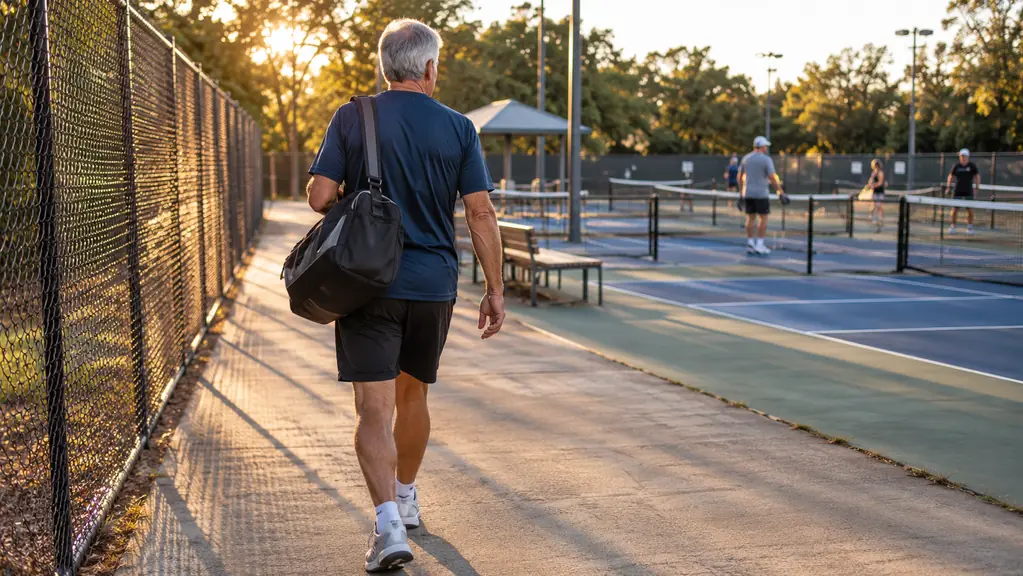
The bag is a sling, so it rides on one shoulder on one adjustable strap. The strap is not padded, and I want to be straight about what that means. A loaded bag carried a hundred yards from the truck to the fence is nothing at all. Carried a mile it would start to complain, and so would my shoulder. My use is the short haul from a parking lot, and for the short haul it is comfortable enough that I forget it is there.
The soft shell is the other half of that equation. Because it is polyester with no frame in it, it collapses down when it is empty, which is how a 15.2 ounce bag ends up living on a shelf in my workshop instead of eating a corner of the garage the way the duffel did. It also means it does not stand up on its own. Set it on a bench and it slumps. Hang it on a fence and it holds its shape fine.
The shoulder strap is the handle, since there is no second grab handle on top. When I pick the bag up off the truck seat, I pick it up by the strap. Six months in, the attachment points have not frayed and the zipper still runs clean without a catch in it, and that zipper is the part I am watching closest.
For comparison, a fella I play with on Tuesdays uses a two strap pickleball backpack with more pockets than mine. He likes it and it clearly holds more gear. I tried it on once and handed it back. Two straps on a bag that makes a fifty yard trip felt like more harness than I needed, and more pockets means more places for me to lose a key. That is a preference, not a verdict. If you carry your gear a long way, his setup is the better answer.
Where It Falls Short
The shell is polyester and soft, and Franklin Sports does not claim it is waterproof. I have had it out in a drizzle with no harm done, but I would not leave it hanging on a fence in a downpour with my phone in the padded pocket. If you play in the rain, plan on a dry bag inside, or leave the electronics in the truck until you are done.
The single main compartment is the other tradeoff. Wet towel, dry towel, bottle, balls and a paddle all share one space unless you use the padded pocket for the phone, which you should. I have come home with a damp towel pressed against a paddle more than once. A simple divider would fix that and there is not one.
One more thing nobody mentions. A soft bag with nothing in it will not stay where you put it. On a breezy afternoon at the park I hung mine on the fence with the pocket open and came back from a game to find it swung around the rail and hanging by the hook. Nothing fell out, luckily. Since then I zip it. It is a two second habit and it has saved me a walk back across the courts looking for loose balls.
And the warranty is 90 days limited, which is short. Nothing on my bag has failed in six months, and zippers are the thing that usually goes first on any bag, so that is the one I keep an eye on. I would rather tell you the number than pretend it does not exist.
What I Liked
- Two paddles lie flat with room to spare, and the listing says up to six
- The built in fence hook keeps the bag off the ground and the paddles facing you
- 15.2 ounces empty, and it collapses flat for storage on a shelf
- Separate padded pocket for a phone and keys, which ended my morning search
- Zipper and strap attachment points have held up over six months of near daily use
Where It Falls Short
- Adjustable shoulder strap is not padded
- Soft polyester shell, not waterproof, and Franklin Sports does not claim it is
- One main compartment, so a wet towel rides against everything else
- 90 day limited warranty is short
- The fence hook only helps outdoors
Who This Is For
This is for the player who drives to the courts, plays a couple of hours, and drives home. It is for the person who is tired of digging a paddle out of a gym bag and tired of setting their gear down on whatever the court surface has on it. If you play doubles on Saturdays and end up carrying for two, it handles that without strain. And if you are the one in your group who already hauls everyone's spare paddles, the six paddle capacity is real and it is the reason Franklin Sports built the bag this way.
Who Should Skip It
If you walk or bike to the courts, a sling on one unpadded shoulder is not the right shape for that trip. If you play in the rain and want your phone and keys to stay dry without a second bag inside, look for something with a water resistant shell. If you already pull a wheeled bag because carrying weight on one shoulder does not suit you, this bag has no wheels and never will. And if you want a compartment for every single item, this is a two pocket design and it will frustrate you by the second week.
Six months in, the fence hook is still the reason I reach for it
18.5 by 13 by 8 inches, 15.2 ounces empty, zipper closure, padded phone and key storage, and a built in fence hook inside the largest pocket. Mine has made the trip from my workshop to the courts more than a hundred times.
Amazon Check Today's Price on Amazon →